Scroll Essays is a scroll-driven data experience: one long page where scrolling is travelling through a scale. There is no score, no timer and no way to lose. You just go down, and every stop is a real number.
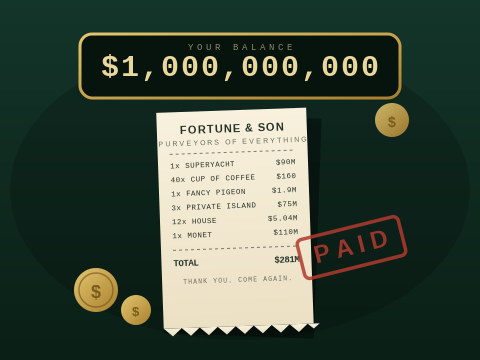
The first subject is The Descent. It starts at the ocean's surface and ends 6,371 kilometres later at the centre of the Earth, passing the sunlit zone, the twilight and midnight zones, the abyss, the hadal trenches, the seafloor, the crust, the mantle, the outer core and the inner core. More subjects are on the roadmap: Deep Time, which scrolls backwards through history, and The Wealth Line, a scale of money.
How to play
Open the game and scroll. That is the whole control scheme: the scroll position inside the window is your depth, shown live in the readout bar along with your zone, the pressure and the temperature.
Milestone cards fade in as you reach them. Each one carries its depth and a single fact: a dive record, a shipwreck, a whale, a borehole, a boundary in the Earth. The scale rail on the left edge ticks past as you fall, so you can watch round numbers go by.
If you scroll past a card that glows green, you found a secret. There are ten hidden easter eggs in The Descent, from a lost rubber duck to a welded borehole cap, and they collect in the sticker panel behind the badge button.
The controls
Button
What it does
Ruler
Compare mode: type a height in metres, or pick one like the Burj Khalifa, and the descent scrolls to where it lands
Sticker
The secrets panel: what you have found, hints for what you have not, and the reset button
Graduation cap
The classroom sheet: every milestone as a flat, printable list
Share
Makes an "I reached X" PNG card of your deepest point, downloaded straight from the browser
Your progress saves itself in the browser. Leave at 62% and the game greets you with "you stopped at 62% last time" when you come back.
The scale is the point
The Descent is not linear. A hundred metres of reef water scrolls past quickly; the hadal trenches take much longer to cross, and the mantle is a very long way indeed. That unevenness is the lesson the essay teaches: the ocean most people picture is only the top of it, and the Earth's skin is thinner relative to its metal heart than most diagrams show.
The gauges on the readout bar are honest about being approximate. Pressure is interpolated between known anchor points and temperature follows a rough geothermal profile, so treat them as feel rather than instrument readings. The milestone numbers themselves are real: dive records, surveyed wrecks, measured depths and the standard boundaries geophysicists use.
For teachers
The graduation-cap button opens the classroom sheet: the entire essay as a flat table grouped by zone, ready to print or project. It needs no interaction and works fine read aloud.
If you are reading this on a device that prefers reduced motion, the drifting particles and card animations switch off automatically, and the classroom sheet gives you the same content as a static list.