About Mycelium
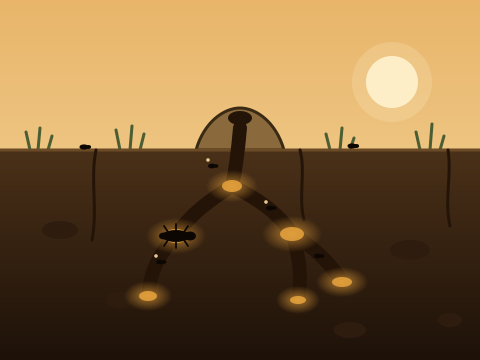
Mycelium is an incremental game played on a living graph. You are a fungus under a dark forest floor: one spore, a hex grid of loam, and the whole wood-wide-web to grow. Hyphae cost nutrients to weave, decay sites feed the network, and named trees pay you sugar in exchange for a steady flow of minerals. What makes it unusual is that the map is real. The path your threads take, how thick they are and how many loops they form genuinely change what the network earns.
How to play
- Click any lit soil hex. The game plans the cheapest path and weaves your threads there.
- Choose what to grow with the toolbar: hyphae are cheap, hyphal cords carry five times the flow, rhizomorphs carry twenty five.
- Grow into leaf litter, logs and carcasses for nutrients and enzymes.
- Reach a plant or tree root, then sign its contract in the Pacts tab.
- Spend enzymes on new body plans and carbon on upgrades in the Season tab.
- Raise fruiting bodies, then bloom to end the season for spores and permanent talents.
The four currencies
| Currency | Where it comes from | What it buys |
|---|---|---|
| Nutrients | Decay sites, strand trickle | Weaving new ground, pruning, fruiting |
| Carbon | Plant and tree contracts | Season upgrades in the Season tab |
| Enzymes | Decomposition nodes | Hyphal cords, fruiting bodies, rhizomorphs |
| Spores | Fruiting bodies and blooming | Permanent talents in the spore tree |
Topology is the mechanic
Every node produces only while connected to the first spore, and how well it produces depends on the path between them. Flow quality is the product of every conduit factor along your best route: a long chain of thin hyphae leaks most of what it carries, while a rhizomorph trunk keeps nearly everything. Redundant loops, meaning two ways for flow to reach the same node, add up to fifteen percent on top.
This makes layout the actual decision. A long thin reach grabs a far tree early but earns weakly and invites nematodes. A dense weave is slower to expand but resilient and rich.
Contracts and the named trees
Plants offer small contracts the moment you touch them: wildflowers, moss mats and shrubs pay a trickle of carbon for a little upkeep. The four named trees are characters:
- Old Birch, close and gentle, the first real contract most networks sign.
- Three Pines, resin-sweet and middling.
- Grey Rowan, deeper east, pays in berries and cold water.
- The Dying Oak, farthest out, the emotional core of the game.
Every contract demands a nutrient flow per second. If your nutrients hit zero for twenty seconds, contracts lapse and the trees judge you in the journal. Sustained pacts deepen at ninety seconds and five minutes, paying half again and then more than double.
Nematodes
Once you sign your first pact, the orange arrives. Nematodes take a thread every couple of minutes: an infested node stops producing, drains a little nutrient and chokes flow through it by two thirds. Left alone about two and a half minutes, it spreads to a neighbour. Select an infested node and prune it for fifteen nutrients. The Bitter rind upgrade and the Nematode bane talent both slow them down.
Seasons and the spore tree
Build a fruiting body on any strand and it banks spores passively while your nutrients stay positive. Blooming ends the season: a fresh forest floor is dealt, your web, currencies, enzyme lessons and carbon upgrades reset, and you keep your spores, talents, species and the Dying Oak's memory. The bloom itself awards extra spores scaled on the carbon you traded that season.
Spore talents are permanent: cheaper growth, wider starting vision, more generous contracts, slower nematodes, a deeper metabolism, and two whole species. Ink cap turns your threads violet and enriches decay; chanterelle turns them amber and sweetens every pact.
The Dying Oak heals one chapter per stretch of tended contract, and it persists across every bloom. Tend it through three seasons and you earn the game's good ending, plus the Healer achievement.
Your save
Progress saves automatically to this browser's local storage every few seconds and whenever the tab hides or closes. Nothing is uploaded. While you are away the network metabolises at fifty percent for up to eight hours, and the welcome back summary lists what grew, which contracts paid and whether nematodes got into the threads.
Frequently asked questions
Do I lose anything when I bloom?
The map, your nodes, nutrients, carbon, enzymes, enzyme unlocks and carbon upgrades all reset. Spores, talents, species, achievements, lifetime statistics and the Dying Oak's progress persist.
Is there an idle option for growing?
The weave assist is built in. Click any sensed hex and the game plans and prices the whole path for you; one more click grows it. You never have to micro individual edges.
Why did my contract stop paying?
Either the tree is unconnected or your nutrients hit zero for twenty seconds and the pact lapsed. Re-tend it from the Pacts tab and add more decay sites or thicker trunks before signing it again.